Professional Ant Extermination Across Ontario
Ants are one of the most widespread household pests in Ontario, with multiple species capable of establishing large populations inside residential and commercial buildings. From the structurally destructive carpenter ant to the tiny but persistent pharaoh ant, each species requires a different treatment approach — and most over-the-counter ant products fail to address the root of the problem because they only kill the foraging workers you see, not the colony producing them.
Effective ant control means targeting the nest. Our treatments use non-repellent residual products and professional-grade baiting systems designed to be carried back to the colony, eliminating the queen and the full population. The result is not just temporary suppression — it is complete elimination with lasting results.
Ant Species Common in Ontario
Understanding which species you are dealing with is the first step to effective treatment. Ontario homeowners commonly encounter four major ant species, each with distinct biology and treatment requirements.
Carpenter Ants
Carpenter ants (Camponotus spp.) are Ontario's most destructive ant species. They are large — black, black-and-red, or all-red, typically 6 to 13mm — and they excavate wood to create nesting galleries, causing structural damage over time. They do not eat wood; they remove it, leaving behind frass (a mixture of wood shavings and waste material) that is often found in basement corners, near window sills, and at the base of wooden structures.
Carpenter ants are particularly attracted to wood that is moist or has been compromised by water damage — window frames with failed caulking, basement framing exposed to groundwater, deck posts, and roof areas with inadequate ventilation. Finding carpenter ants inside in large numbers, particularly in late winter or early spring, often indicates an established interior nest rather than foragers from an exterior colony.
Pavement Ants
Pavement ants (Tetramorium caespitum) are small, 2.5 to 3mm dark brown to black ants that build nests under pavement, sidewalks, driveways, and concrete foundation slabs. They are commonly seen pushing up fine soil along driveway cracks and concrete expansion joints and entering homes through foundation cracks, utility penetrations, and gaps around plumbing.
Pavement ants are highly persistent foragers. They create well-established trails from their underground nests to interior food sources and will continue to use the same routes even after surface cleaning. Elimination requires treating the exterior population and eliminating interior entry points.
Pharaoh Ants
Pharaoh ants (Monomorium pharaonis) are tiny — just 1.5 to 2mm — and light yellowish-brown. They are a major problem in multi-unit residential buildings, hotels, hospitals, and food service facilities because they establish decentralized colonies with multiple queens throughout a building. A single pharaoh ant colony can fragment across dozens of wall voids, electrical boxes, and other protected harborage sites.
Critically, pharaoh ants must never be treated with repellent sprays. Spray treatment causes "budding" — the colony detects the threat and splits, with queen groups moving to new locations. This scatters the infestation rather than eliminating it and dramatically worsens the problem. Pharaoh ants must be controlled exclusively with slow-acting gel bait that workers carry back to each colony fragment.
Odorous House Ants
Odorous house ants (Tapinoma sessile) are small, dark ants named for the distinctive rotten coconut smell released when crushed. They nest both outdoors and indoors, establishing satellite colonies inside wall voids, under flooring, and in insulation. Like pharaoh ants, they can develop large multi-queen populations inside structures that are difficult to control with spray products alone.
Why Over-the-Counter Ant Products Often Fail
Most consumer-available ant control products — sprays, dusts, granules — are repellent-based. They kill or deter the ants that contact them, but they do not eliminate the colony. The worker ants you are seeing on the floor of your kitchen represent a fraction of the total population. The queen and the majority of the colony remain in the nest, undisturbed, continuing to produce new workers.
Repellent products also disrupt ant trails. Ants use pheromone trails to navigate. When a trail is broken by a spray barrier, the foraging workers simply find an alternative route. The colony adapts. This is why homeowners often find that repeated spraying with consumer products provides only days of relief before ant activity resumes — and sometimes causes it to spread to new areas of the home.
Our Ant Control Treatment Process
Inspection and Species Identification
Every ant service begins with a thorough inspection to identify the species present, locate the nesting site if possible, and map all entry points and active trails. Species identification matters significantly — a carpenter ant problem requires a different product approach than a pharaoh ant problem, and misidentification leads to ineffective treatment.
Non-Repellent Exterior Treatment
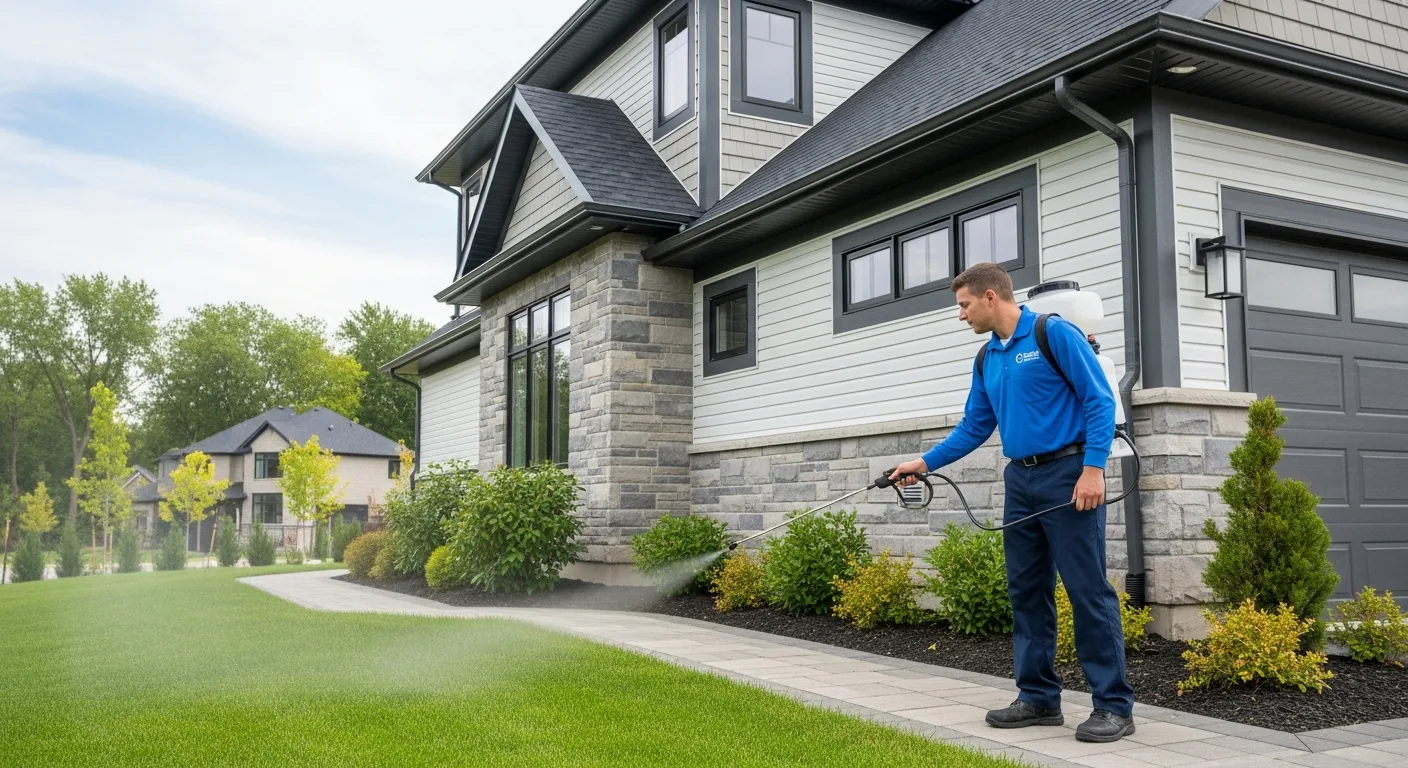
For carpenter ants, pavement ants, and odorous house ants, we apply professional-grade non-repellent residual insecticide around the full exterior perimeter of the structure. Ants cannot detect these products and walk through them, picking up a lethal dose that is then transferred to nestmates through grooming and contact. Non-repellent products eliminate the colony far more effectively than repellent barriers, which ants simply route around.
Gel Bait Application
For pharaoh ants and interior ant infestations, we apply professional-grade gel bait at all active foraging locations. The bait is formulated to be highly attractive to workers, who carry it back to the colony and feed it to other colony members including the queens. This disrupts the reproductive capacity of the colony and leads to complete population collapse over one to two weeks.
Entry Point Treatment and Sealing
We identify and treat all active interior entry points — gaps around plumbing pipes, foundation cracks, expansion joints, utility penetrations, and door and window frames. For carpenter ant infestations with confirmed interior nesting, we apply direct injection treatment to void areas and recommend structural sealing after elimination.
Follow-Up
We schedule follow-up contact to confirm activity has ceased and to address any residual populations that may require additional treatment. Our goal is complete colony elimination — not temporary suppression.
Ant Control for Businesses in Ontario
Ant infestations in commercial food environments present immediate health code risk. Any visible ant activity in a kitchen, food storage, or dining area can result in a health inspection failure and regulatory action. We provide commercial ant control programs for restaurants, food processors, multi-unit residential buildings, and office facilities. Programs include scheduled preventative visits, documentation, and priority response to active activity. Learn more about commercial pest control.
Ant Control Service Areas in Ontario
We provide ant extermination services across Ontario including Vaughan, Toronto, Mississauga, Brampton, Richmond Hill, Markham, Oakville, and surrounding communities.